Q3 FY2026: Bookings surge 45%, Q3 loss narrows as recovery gains traction
Quarter ended . Reported .
Score
Mixed
3 of 5
PoorStrong
Year-over-year revenue declined 15% and the company posted a net loss, but sequential improvement is evident: operating loss narrowed 51%, adjusted EBITDA returned to positive, and bookings hit a four-quarter high. Management expects Q4 to be substantially stronger with positive adjusted net income, though tariff headwinds and competitive pressures persist.
Headline metrics
Revenue
$827.4M
-15%
Lift Truck revenue $775.5M, Bolzoni Group $82.3M
Diluted EPS
($0.83)
n.m.
Adjusted EBITDA
$6.0M
+$11.0M
Returned to positive from ($4.9M) in Q2 2026
Bookings
$550M
+45%
Fourth consecutive quarter of elevated bookings
Unit Backlog
$1,600M
+19%
Represents approximately 5 months of production
Operating Cash Flow
$26M
+$10M
Improved from Q2 2026 on stronger earnings and working capital execution
Year-over-year change versus Q3 FY2025.
The quarter
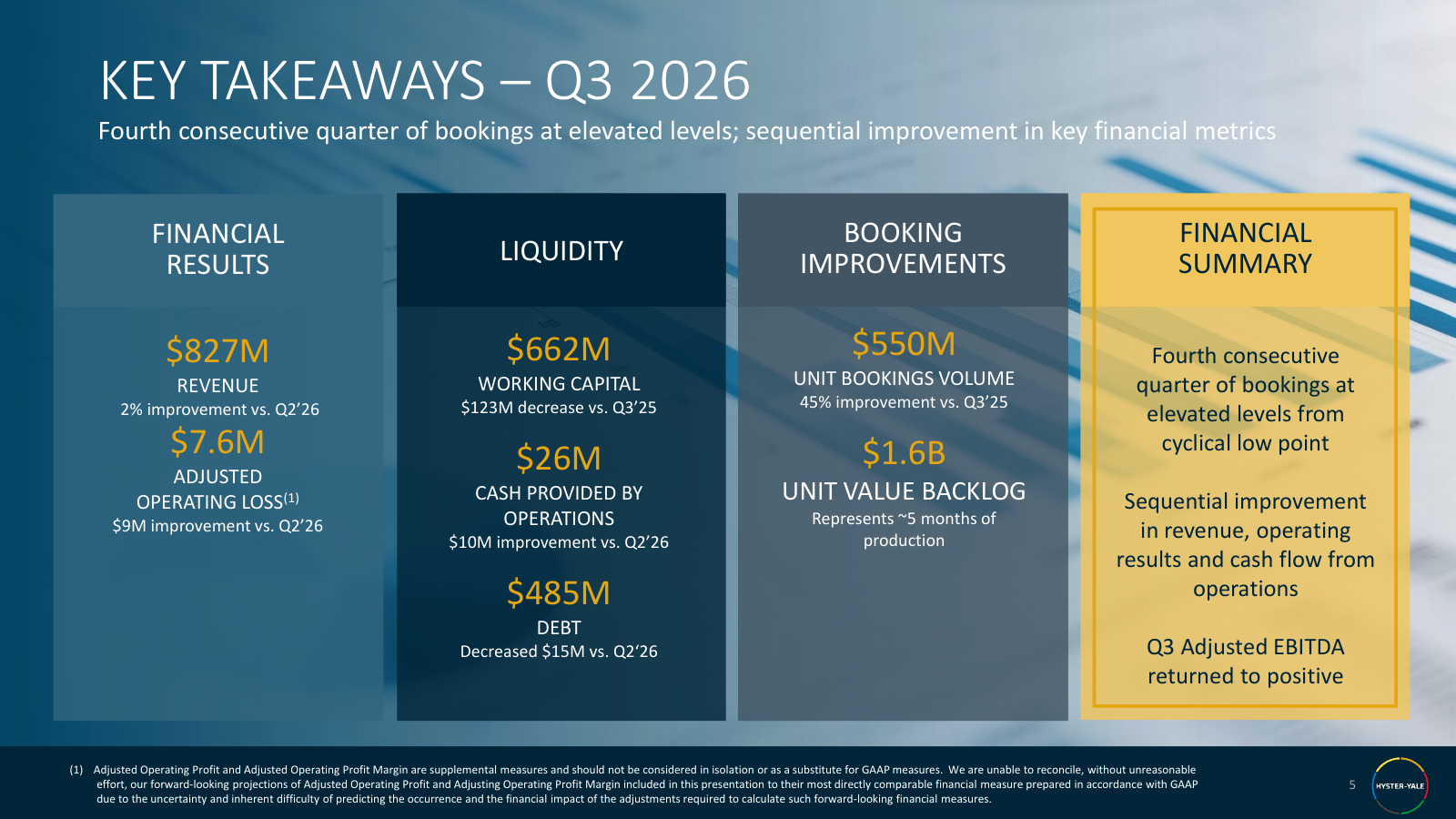
Hyster-Yale reported Q3 2026 revenue of $827.4 million, down 15% year-over-year but up 2% sequentially as stronger bookings began converting to shipments. The company posted a net loss of $14.9 million, or $0.83 per share, compared to a $2.3 million loss in Q3 2025. However, sequential improvement was pronounced: the operating loss narrowed from $18.4 million in Q2 to $9.1 million in Q3, and adjusted EBITDA returned to positive at $6.0 million after a negative $4.9 million in Q2.
Bookings of $550 million in Q3 marked the fourth consecutive quarter of elevated bookings from the cyclical low in Q2 2025, up 45% year-over-year. The backlog stood at $1.6 billion, representing approximately five months of production. The year-over-year revenue decline was driven by unfavorable product mix—customers shifted toward lighter-intensity, lower-priced models—and lower shipment volumes, partially offset by positive pricing of $11 million. Lift Truck gross profit fell 21% year-over-year to $106.5 million, though the company noted that recently introduced lighter-intensity products gained market acceptance and supported market share gains.
Working capital improved $123 million year-over-year to $662 million, with inventory down $76 million and days inventory outstanding improved five days. Operating cash flow increased to $26 million in Q3, up $10 million from Q2, enabling a $15 million debt reduction. The company maintained its long-term capital allocation priorities of debt reduction, reinvestment for profitable growth, and shareholder returns, paying $20 million in dividends year-to-date.
Management expects Q4 2026 to deliver substantially stronger operating performance, with bookings expected to exceed both Q4 2025 and Q3 2026 levels. Higher shipment volumes are anticipated to drive sequential revenue growth and improved manufacturing absorption. Gross profit and margin are expected to improve on higher production volumes and the benefits of pricing, sourcing, and cost-reduction actions, though tariff-related costs are expected to remain elevated. Adjusted net income is expected to return to positive levels in Q4, excluding anticipated implementation costs for new programs.
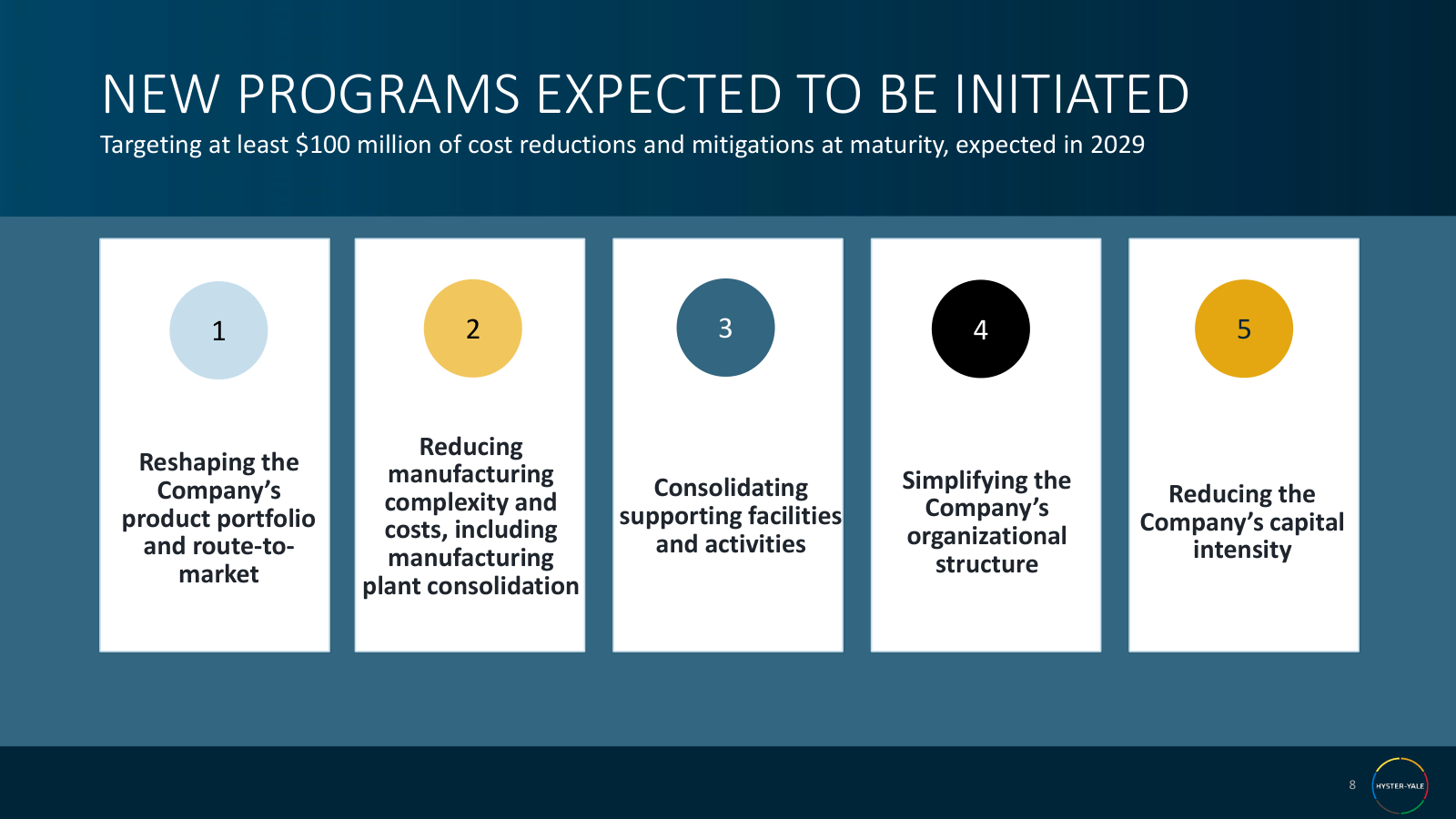
In Q4 2026, the company launched major new operational initiatives and cost-reduction programs targeting at least $100 million of annual cost savings at maturity in 2029. The initiatives include reshaping the product portfolio and exiting hydrogen fuel cell and HydroCharge businesses, reducing manufacturing complexity through plant consolidation, consolidating supporting facilities, simplifying organizational structure, and reducing capital intensity. Implementation costs are estimated at least $50 million, with the company expecting 2026 capital expenditures of $50 million to $60 million and 2027 capital expenditures limited to $40 million to $50 million.
M&A
No acquisitions or divestitures announced this quarter.